Disinfecting Equipment and Treatment
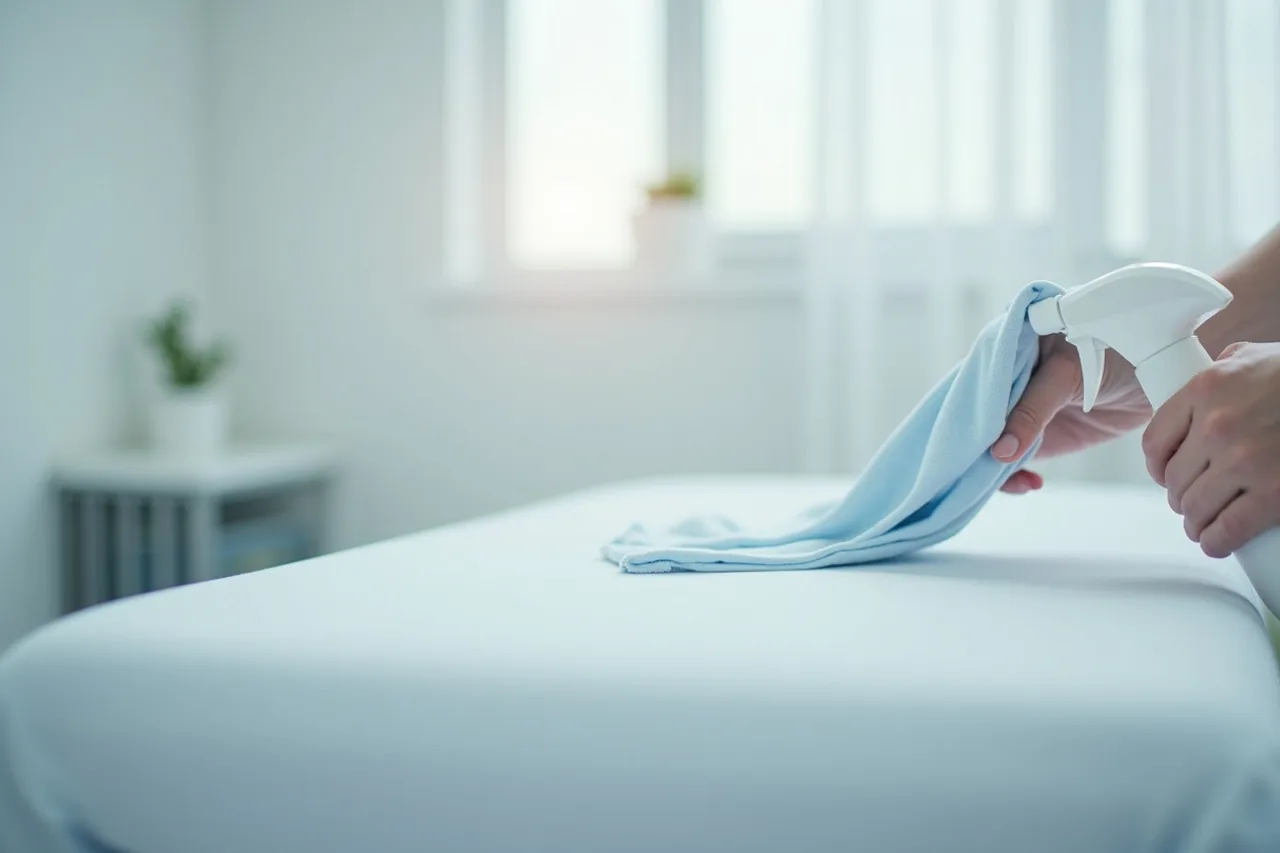
During an inspection at Kate's practice, the Sanitary Inspectorate (Sanepid) inspector walked up to the treatment couch, ran a finger over the surface.
During an inspection at Kate's practice, the Sanitary Inspectorate (Sanepid) inspector walked up to the treatment couch, ran a finger over the surface, and asked: "What do you disinfect this with, and how often?" Kate replied that she "wipes it down with a solution after every patient." The inspector pressed further: "Which product? Do you have the safety data sheet? Do you keep a log?" She had no answer. The result: a note in the report and 30 days to implement a disinfection procedure and log.
Disinfection is the area where physiotherapy practices most often receive notes from inspectors. Not because they don't clean -- but because they don't document it. In this article we'll show you how to build a disinfection procedure for the treatment couch and equipment, which products to choose, and how to keep a log that will satisfy an inspector.
Why is disinfection so important?
A physiotherapy practice is a place of close physical contact. The patient's skin touches the treatment couch, the therapist touches them with their hands, equipment touches the body. Without proper disinfection, the risk of transmitting skin infections, fungal infections or other infections increases.
The legal basis for these requirements is:
- The Act of 5 December 2008 on preventing and combating infections and infectious diseases in humans
- The Regulation of the Minister of Health on the requirements to be met by the premises and equipment of an entity carrying out medical activities
- Guidelines from the State Sanitary Inspectorate for healthcare entities
Three levels of cleanliness -- know the difference
In your practice you apply three levels of processing:
- Cleaning (washing) -- removing visible dirt with water and detergent. Always precedes disinfection.
- Disinfection -- destroying microorganisms using a disinfectant. The basic level in physiotherapy.
- Sterilisation -- complete destruction of all forms of microorganisms. Rarely needed in physiotherapy. For dry needling you use sterile single-use needles (nothing is sterilised in the clinic) -- what matters is aseptic technique and a rigid container for used needles (waste code 18 01 03*).
What to disinfect, and how often?
| Item | Frequency | Type of product |
|---|---|---|
| Treatment couch | after every patient | surface product, bactericidal and virucidal |
| Ultrasound heads, TENS electrodes | after every patient | product compatible with the material (per manufacturer's instructions) |
| Treatment room floor | at least once a day | product for large surfaces |
| Door handles, worktops, reception | at least once a day | surface product |
| Reusable equipment (rollers, bands) | after every patient | surface product |
| Toilet, washbasin | at least once a day | sanitary product |
The key rule: items in direct contact with the patient's skin are disinfected after every patient, general surfaces at least once a day.
How to choose a disinfectant?
Not every liquid is suitable for a medical practice. The product should:
- have a biocidal product authorisation (authorisation number on the label) or be a medical device
- have a defined spectrum of activity (B -- bacteria, F -- fungi, V -- viruses, Tbc -- mycobacteria)
- state the contact time (how many minutes it must act for)
- be compatible with the surface material (e.g. the couch's upholstery)
For ultrasound heads and electrodes, use only products recommended by the equipment manufacturer -- an unsuitable product can damage the equipment and void the warranty.
Safety data sheet (SDS) -- mandatory
For every disinfectant you must have a safety data sheet (SDS) for the hazardous substance. This is a document from the manufacturer containing its composition, hazards, rules for safe use and first aid. The Sanitary Inspectorate inspector almost always asks for it.
Keep the data sheets in a folder available at the workstation. The manufacturer or wholesaler provides them free of charge -- just ask by email.
Disinfection procedure -- a template to implement
Your written procedure should include:
```
TREATMENT COUCH DISINFECTION
When: after every patient
Step 1: remove visible dirt with a cloth and detergent
Step 2: spray the surface with [product name]
Step 3: wait for the contact time: [X minutes per label]
Step 4: wipe dry if needed
Step 5: record it in the disinfection log
Product: [name, concentration]
SDS: available in the folder at the workstation
```
Disinfection log -- the heart of the documentation
The log is proof that disinfection actually takes place. It should include:
- date and time
- what was disinfected (couch, floor, ultrasound head)
- product and concentration used
- contact time
- person responsible (signature)
Example entry:
```
2026-05-15, 09:15, Room A -- couch after patient
Product: Product X 0.5%, 5-minute contact time
Performed by: Anna Nowak
```
The log can be kept on paper or electronically. The inspector checks its continuity -- whether there are large, unexplained gaps.
CTA: Don't want to build procedures from scratch? FizjoReady's STANDARD package includes a ready-made treatment couch and equipment disinfection procedure, a disinfection log template, and a checklist of products required by the Sanitary Inspectorate. Just fill in the product names and you're done. See FizjoReady packages →
Hand hygiene -- an often overlooked element
Surface disinfection is one thing, but the therapist's hand hygiene is just as important. There should be a dispenser with an alcohol-based hand disinfectant (min. 60-70%) at the workstation. Hands are disinfected before and after contact with the patient. It's worth displaying instructions for correct hand washing and disinfection (the WHO scheme).
The most common disinfection mistakes
- No written procedure or log (simply "wiping down" isn't enough)
- Too short a contact time -- spraying and immediately wiping dry doesn't disinfect
- Using a product without biocidal authorisation, or one that's out of date
- No safety data sheets
- Using the same product for everything, without checking compatibility with equipment
- Paper couch covers instead of disinfection (a cover doesn't replace disinfecting the frame and sides)
Frequently asked questions
Does a paper couch cover exempt me from disinfection?
No. A disposable cover protects the top surface, but not the sides, headrest or frame, which the patient also touches. You replace the cover after every patient, but you still disinfect the couch surfaces. Treat the cover as a supplement, not a substitute, for disinfection.
How long do I need to keep the disinfection log?
There's no single fixed rule, but in practice it's worth keeping the log for at least 3-5 years, so you can demonstrate continuity during an inspection. Many inspectors ask to see records from the last few months, so keep the current log close at hand at all times.
Can I use an ordinary surface cleaner to disinfect an ultrasound head?
This isn't recommended. Ultrasound heads and electrodes require products specified by the equipment manufacturer, because aggressive products can damage the head's membrane. Check the device's instructions and use only compatible products -- otherwise you risk losing the warranty and damaging the equipment.
What's the difference between disinfection and sterilisation in physiotherapy?
Disinfection destroys most microorganisms and is sufficient for surfaces and reusable equipment that comes into contact with intact skin. Sterilisation destroys all forms of microorganisms; in physiotherapy it is rarely performed on site -- for skin-breaking procedures such as dry needling you use sterile single-use needles and dispose of them in a rigid sharps container. In typical physiotherapy, sterilisation usually isn't required.
CTA: Want a disinfection procedure and log ready for a Sanitary Inspectorate check? FizjoReady's STANDARD package gives you the complete set in one file. See FizjoReady packages →
Related articles:
- Sanitary Inspectorate check at a physiotherapy practice
- Premises requirements for a physiotherapy practice
- Most common compliance mistakes in a physiotherapy practice